01
Fragmented certification
Five to ten different standards for one product
From coffee to timber, multiple certification schemes run in parallel. Compliance cost rises and ownership of the process fragments.
10+
distinct schemes
4–7
process layers
EUDR compliance is not only regulation — it is end-to-end operations. Bring data collection, geolocation, risk and declarations together in one enterprise platform.
Page flow
EUDR pulls decades of fragmented compliance, missing transparency and the climate crisis under one regulatory roof. Four structural issues explain why the Regulation took shape so decisively.
Five to ten different standards for one product
From coffee to timber, multiple certification schemes run in parallel. Compliance cost rises and ownership of the process fragments.
File-based documentation
Separate document packs per supplier, mixed formats and chasing by email. Data quality falls and reporting timelines stretch.
Origin hard to trace
In multi-tier supply chains, the parcel behind a commodity is often unknown. Traceability barely exists.
420 million hectares in three decades
Since 1990 the world has lost forest area on the order of Libya’s land area. Most of that loss is linked to agricultural expansion.
In answer to those structural gaps, EUDR makes deforestation-free supply a legal obligation.
From micro and small enterprises to large operators; producer, exporter and importer roles are all in scope. The depth of obligations varies with scale.
The party that produces the raw material and moves it across borders. They must evidence origin and legality; even if a non-EU person places the product on the market abroad, the Union-established operator that first places it on the Union market is typically the operator in scope.
The natural or legal person established in the Union that first places the product on the Union market is the EUDR operator (including where production is in a third country). DDS submission, due diligence and source verification attach to this role.
The party purchasing within the EU supply chain. They demand evidence, DDS references and traceability visibility; downstream verification duties may also apply.
A five-step flow from regulation to declaration and sharing. At each step ERWAY collapses scattered work into one screen.
At the centre: the EU regulation sets the frame, the company collects data, the supplier confirms origin, ERWAY runs risk analysis and prepares the declaration — and the buyer reaches an authorised view.
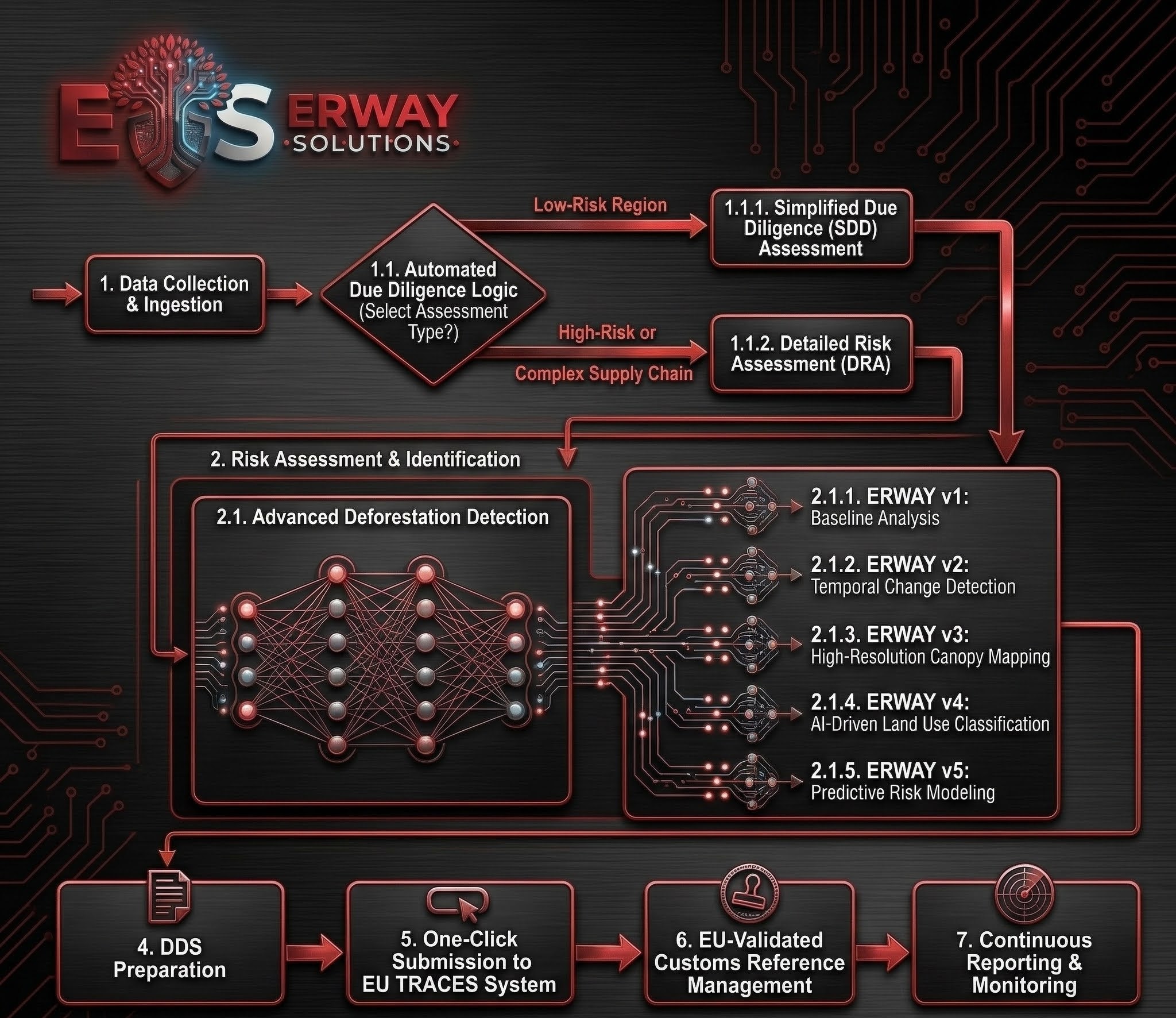
The European Union sets deforestation-free, legality and declaration obligations for commodities placed on the internal market.
The company collects geospatial data and supplier information for raw materials. Company profile and authorisations are defined in ERWAY.
The supplier enters corporate identity and parcel / polygon data for the plots where the raw material was produced.
Evidence-based, multi-category risk analysis is performed on geolocation and supplier data.
Where customs clearance applies, a DDS is submitted; otherwise evidence and traceability are shared with the buyer.
EUDR expects evidence-backed answers to who–where–what at every link. ERWAY manages the full chain from supplier identity to the customs declaration as one whole.
The farm, plantation or forest area where the raw material was produced.
The EU wants the source of the commodity, plot boundaries and the production chain on evidence, not thin paperwork — live data instead.
Plot → raw material → production → export is managed in one context. Data gaps disappear.
For each link, date, source, authorisation and the document chain are recorded automatically.
Outcome: Which parcel a coffee bean came from, through which supplier, to which buyer — becomes traceable from a single screen.
ERWAY’s risk engine has two major layers: satellite-based environmental screening and ESG-grade social conformance. Both are scored at parcel level and produce audit-ready evidence.
Spread of plantations such as palm and soy into forest areas.
Inspections verify operator and trader compliance and product conformity; they are risk-based and may generally be unannounced.
Every risk category is scored at parcel level; outputs feed EU inspections and the DDS automatically.
Explore the risk engineHS headings aligned with the EU Combined Nomenclature (CN) are listed with concise English descriptions. Cards summarise; click for a plain, scannable code table.
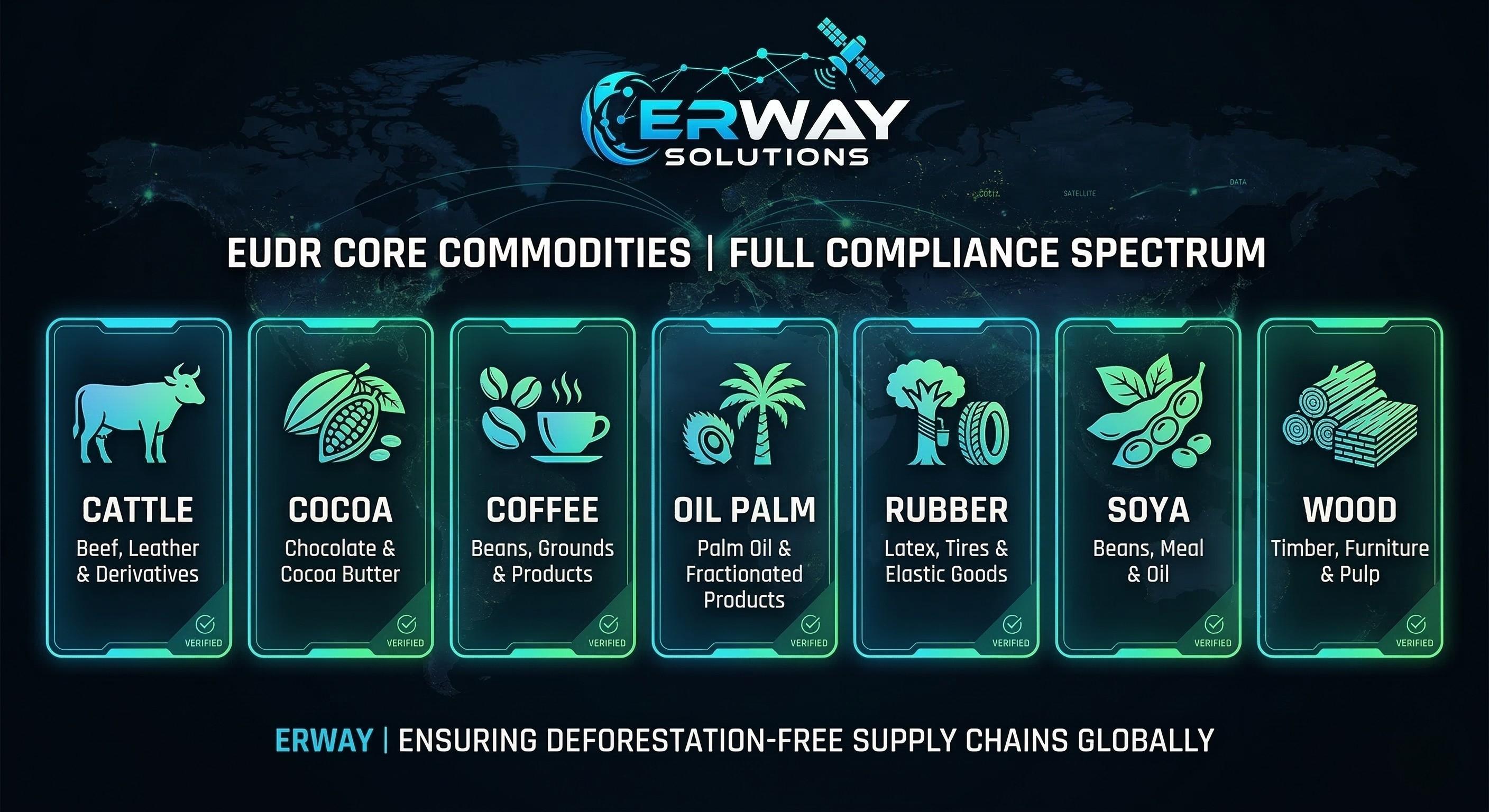
All seven commodities and related CN lines (partial coverage marked “ex”) map to product–code links in ERWAY.
A Due Diligence Statement (DDS) is the filing operators submit to the competent authority before placing EUDR commodities on the EU internal market. Under the EUDR Third Edition, the operator that first places the product on the market is primarily responsible for the DDS; downstream operators usually retain and pass through the upstream DDS reference. See the legal framework section on this page for a fuller summary.
Are you the party clearing the product through EU customs?
The DDS obligation sits with the operator that first places the product on the EU internal market. Answer the questions to see how your role fits.
This summary compiles the EU Deforestation Regulation (EUDR) for a business-oriented read. Updates under the EUDR Third Edition are outlined in the first panel. For binding obligations, rely on the consolidated official text and qualified advisers.
Base regulation: (EU) 2023/1115. Third Edition amendments and definitive dates must be verified against EUR-Lex / Official Journal.
How to read this. The sage-tinted badge is a short topic / article label; the larger line below is the headline summary. Click to expand the detail.
The Third Edition keeps the regulation’s core: products placed on the EU market must not come from land deforested or degraded after 31 December 2020, and must comply with the production country’s relevant laws. New elements cluster mainly under four headings.
EUDR enforcement is not limited to administrative fines. Trading relationships, contractual duties and market trust are affected too. ERWAY provides a preventive framework for both layers.
An operational layer that goes beyond simple yes/no checks — evidence chains, supply visibility and buyer sharing on one platform.
ERWAY is the operational layer that turns EUDR readiness from a compliance burden into a competitive edge.